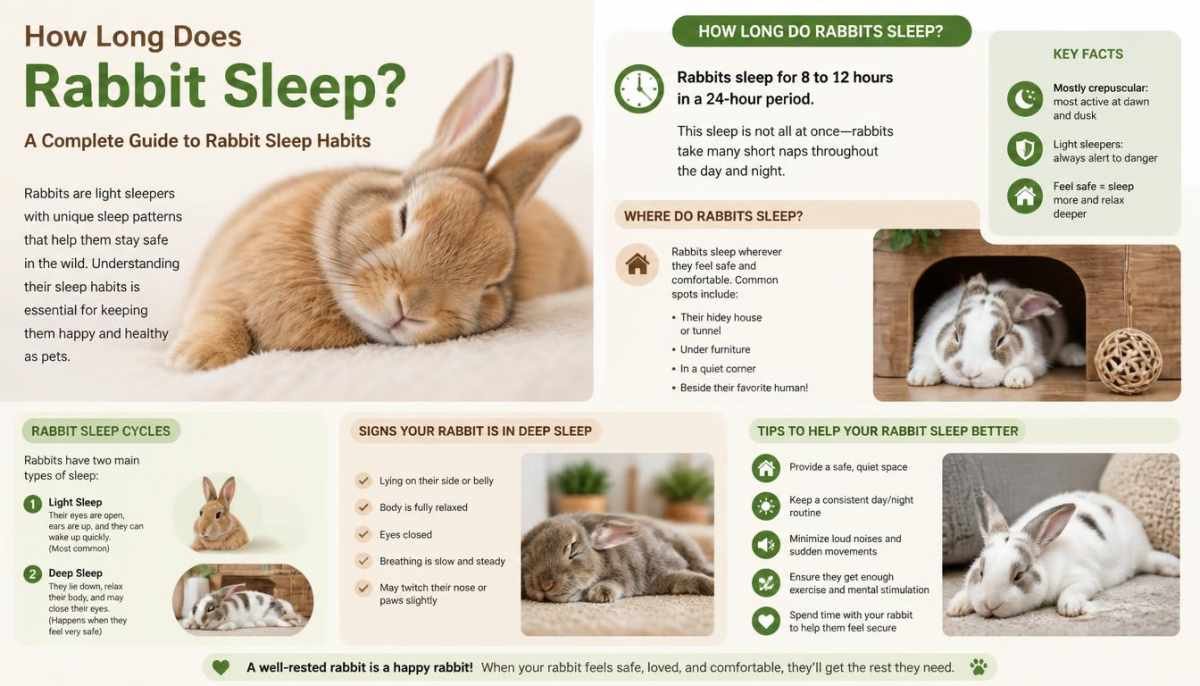
\If you have a pet rabbit, you may have noticed something confusing: your bunny seems to nap for hours during the day, but suddenly becomes active when you are getting ready for bed. You might even see your rabbit lying completely still with its eyes open and wonder whether it is actually sleeping.
So, how long does rabbit sleep in a typical day? Most adult rabbits sleep around 8 to 12 hours in a 24-hour period, although individual sleeping habits vary. Unlike humans, rabbits usually do not sleep for one long stretch. Instead, they take multiple short naps throughout the day and night.
Understanding your rabbit’s sleep pattern can help you provide a comfortable environment and recognize when a change in behavior might indicate a health problem.
How Long Does Rabbit Sleep in a Day?
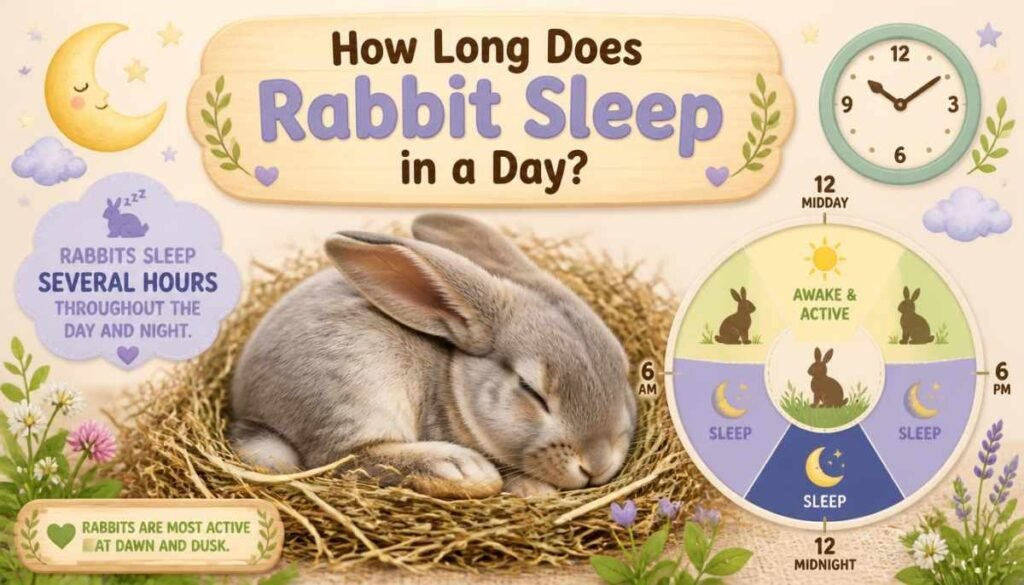
Most healthy adult rabbits sleep approximately 8 to 12 hours every 24 hours. However, you may not notice all those hours because rabbits spread their rest across many short periods.
Your rabbit might nap in its hideout in the afternoon, rest quietly in the evening, and become more energetic around sunrise or sunset. These changes are normal for an animal that naturally alternates between resting and exploring.
Age, personality, activity level, environment, and health can all influence how much a rabbit sleeps. Some rabbits appear to nap frequently, while others spend more time exploring their surroundings.
The important thing is to learn what is normal for your own rabbit. A bunny that eats well, produces normal droppings, moves comfortably, and responds to its environment is generally less concerning than one that suddenly becomes unusually sleepy or withdrawn.
When Do Rabbits Sleep?
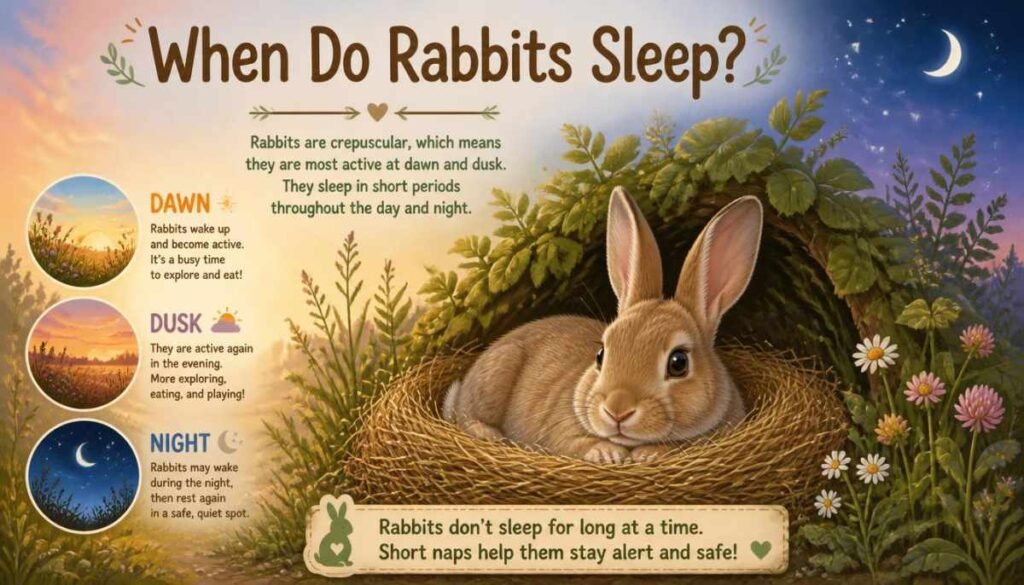
Rabbits have a different daily rhythm from humans. They are generally described as crepuscular, meaning they tend to be most active around dawn and dusk.
Do Rabbits Sleep During the Day?
Yes, rabbits often rest during the daytime, particularly around the middle of the day. You may find your bunny stretched out in a quiet corner, resting inside a hideout, or sitting with its eyes partly closed.
These daytime naps are a normal part of rabbit behavior. Your rabbit may wake up periodically to eat hay, drink water, groom itself, explore, or use its litter box before settling down again.
Avoid assuming that a rabbit is bored or unwell simply because it rests during the afternoon. Look at its overall behavior, appetite, and activity throughout the day.
Do Rabbits Sleep at Night?
Rabbits also sleep at night, but they may wake up frequently and become active at different times. You might hear your rabbit eating hay, moving around its enclosure, digging, or exploring while you are trying to sleep.
Because rabbits do not usually sleep continuously for eight hours, a quiet bedroom or a dark room does not necessarily mean your bunny will remain asleep all night.
If your rabbit lives indoors, provide a safe enclosure with enough room to move, comfortable resting areas, and access to hay and water. Avoid keeping a rabbit in a small cage simply because you want it to sleep quietly overnight.
Are Rabbits More Active at Dawn and Dusk?
Many rabbits become especially active during the early morning and evening. These periods often include exploring, eating, running, playing, and interacting with their surroundings.
Your rabbit may seem energetic just as you are waking up or settling down for the night. This is normal for many rabbits and does not necessarily mean they are sleeping too little.
Providing enrichment and safe exercise opportunities during these active periods can help your rabbit maintain a healthy daily routine.
How Much Sleep Do Rabbits Need at Different Ages?
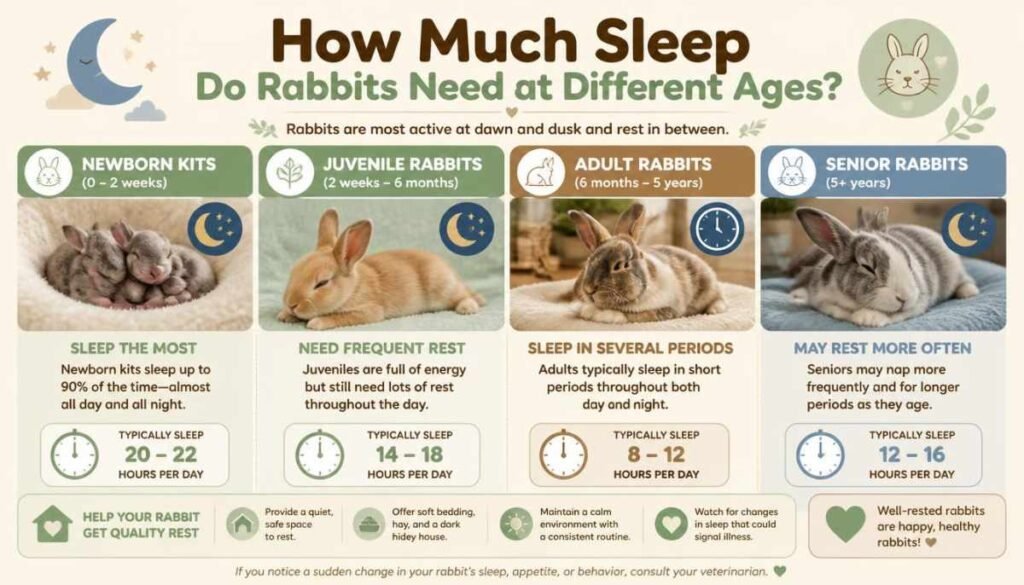
A rabbit’s sleeping habits can change as it grows. Younger rabbits may rest more frequently, while adults often develop more predictable patterns. Older rabbits may also spend more time resting, although health and comfort play important roles.
The following figures are general estimates rather than strict requirements for every rabbit.
| Rabbit age | Approximate daily sleep |
| Baby rabbits, up to 3 months | May sleep around 16–18 hours |
| Young rabbits, 3–6 months | May sleep around 14–16 hours |
| Junior rabbits, 6–12 months | May sleep around 12–14 hours |
| Adult rabbits, 1–5 years | Commonly around 8–12 hours |
| Senior rabbits, 5 years and older | May sleep around 12–14 hours |
These age-based ranges are approximate and can overlap. There is no single sleep duration that applies to every rabbit of a particular age.
How Long Do Baby Rabbits Sleep?
Baby rabbits spend much of their early development growing and resting. Their sleep needs and behavior change as they mature, and they may appear less active than older rabbits at certain times.
Very young kits normally stay in their nest for much of the day. Their mother typically visits briefly to nurse them rather than remaining beside them continuously.
If you are caring for baby rabbits, avoid disturbing the nest unnecessarily. If a kit seems weak, cold, injured, or is not developing normally, contact a rabbit-experienced veterinarian.
How Long Do Young Rabbits Sleep?
Young rabbits are developing quickly and often alternate between energetic play and frequent rest. You may see them sprint, jump, explore, and then settle down for another nap.
As they mature, their activity patterns can become more predictable. Give them enough space to move, appropriate toys, unlimited grass hay, and opportunities to explore safely.
How Long Do Adult Rabbits Sleep?
Adult rabbits commonly sleep around 8 to 12 hours across a full day. Their sleep usually comes in short periods rather than one continuous stretch.
An adult rabbit may spend part of the afternoon resting, become active in the evening, and take additional naps overnight. Individual differences are normal, so focus on your rabbit’s usual behavior rather than counting every minute of sleep.
Do Senior Rabbits Sleep More?
Older rabbits may spend more time resting, particularly if they have arthritis, reduced mobility, or another health condition. However, age alone does not explain every change in sleep behavior.
Make sure your senior rabbit can reach its food, water, litter box, and resting area without difficulty. Provide soft, comfortable resting spots and non-slip flooring where needed.
If your rabbit suddenly becomes less active, has difficulty moving, stops eating normally, or seems uncomfortable, seek veterinary advice rather than assuming it is simply getting older.
How Do You Know If Your Rabbit Is Sleeping?
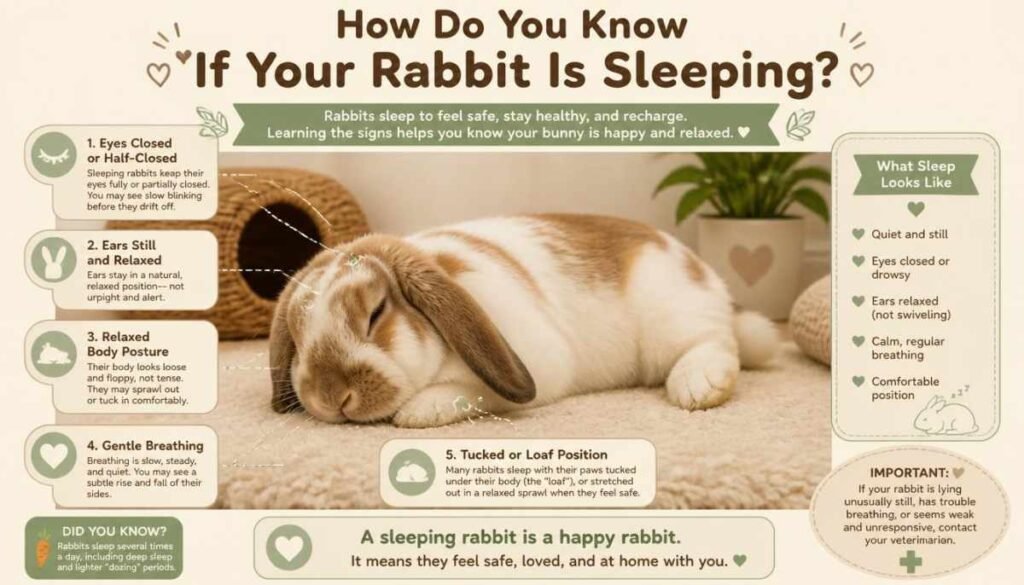
Rabbits can sleep in positions that look unusual to people. Because they are prey animals, they may remain alert to sounds and movement even while resting.
Learning to recognize common sleeping positions can help you understand your bunny’s behavior.
Sleeping With Eyes Open
Rabbits sometimes rest or sleep with their eyes open or partly open. This behavior is associated with their natural need to remain alert to potential danger.
A rabbit with open eyes may still be resting. Look for other signs, such as relaxed muscles, reduced movement, and a comfortable posture, rather than relying only on its eyes.
Some rabbits close their eyes more often when they feel secure in their environment.
Sleeping With Eyes Closed
A rabbit that closes its eyes while resting may feel safe and comfortable. You may see it sitting with its head lowered or lying in a relaxed position.
Not every rabbit closes its eyes for every nap, so this is not the only sign of normal sleep. The important point is whether the rabbit can wake and respond normally when appropriate.
The Rabbit Flop
One of the most surprising rabbit behaviors is the flop. Your bunny may suddenly roll onto its side, stretch out, or fall into a relaxed position.
Although this can look alarming the first time you see it, a relaxed rabbit flop is often a sign that the animal feels comfortable enough to rest deeply.
However, do not assume every rabbit lying on its side is sleeping. If the rabbit appears unresponsive, struggles to breathe, cannot get up, or shows other signs of distress, seek emergency veterinary care.
Sleeping in a Loaf Position
A rabbit may tuck its feet underneath its body and sit in a compact position often called a loaf. This can be a normal resting posture, particularly when the rabbit is relaxed.
A comfortable loaf usually looks different from a tense, hunched posture associated with possible pain. If your rabbit is tightly hunched, reluctant to move, grinding its teeth loudly, or eating less than usual, contact a veterinarian.
Where Do Rabbits Like to Sleep?
Rabbits generally prefer quiet, sheltered places where they can rest without feeling exposed. A suitable sleeping area helps them feel secure while allowing them to move freely whenever they wake.
A Quiet Hideout
Provide a hideout or covered shelter where your rabbit can retreat when it wants privacy. A cardboard box with safe openings or a suitable rabbit hide can work well.
Make sure the hideout is large enough for your rabbit to turn around and stretch comfortably. It should also have safe entrances and exits.
Soft and Comfortable Flooring
Rabbits need comfortable flooring that supports their feet. Solid, non-slip surfaces and appropriate bedding can help them rest more comfortably than bare wire flooring.
Keep the resting area clean and dry. Damp bedding and dirty surfaces can contribute to skin and foot problems.
A Safe Indoor Enclosure
An indoor rabbit needs enough room to move, stretch, stand comfortably, and explore. A small cage alone is not an adequate long-term living space.
Include a hideout, litter box, unlimited grass hay, fresh water, and safe enrichment. Your rabbit should have opportunities for exercise and exploration throughout the day, not only when you let it out briefly.
A Peaceful Environment
Sudden loud noises, rough handling, and frequent disturbances can make rabbits feel unsafe. Place the resting area somewhere reasonably quiet while still allowing your rabbit to observe its surroundings.
Keep other pets from disturbing a resting rabbit. If your bunny hides more than usual, consider whether noise, household changes, or an uncomfortable environment may be affecting it.
What Can Affect How Long a Rabbit Sleeps?
Not every rabbit follows exactly the same schedule. Several factors can influence how long your bunny rests and when it becomes active.
Age and Development
Baby and young rabbits may have different rest patterns from healthy adults. Senior rabbits may also rest more because of changes in mobility or general health.
Compare your rabbit’s behavior with its usual pattern and consider its age before assuming that a particular number of sleeping hours is abnormal.
Temperature and Weather
Rabbits may change their activity patterns depending on temperature and environmental conditions. Hot weather can make them less active, and overheating is a serious risk for rabbits.
Provide shade, good ventilation, fresh water, and a comfortably cool environment. Watch for signs of heat stress, including rapid breathing, weakness, or unusual lethargy, and seek urgent veterinary help if these occur.
Exercise and Enrichment
Rabbits need opportunities to move, explore, dig, forage, and play. A rabbit with enough space and appropriate enrichment may alternate between active periods and relaxed naps.
A lack of stimulation can contribute to boredom and unwanted behavior. Provide safe toys, tunnels, hiding places, and opportunities to explore a rabbit-proofed area.
Stress and Changes in the Environment
Moving to a new home, introducing another animal, loud construction, or changes in routine can affect a rabbit’s behavior.
A stressed rabbit may hide more often or appear less willing to explore. Give it a secure place to retreat and allow it time to adjust.
If the behavior change persists or occurs alongside reduced eating, abnormal droppings, or signs of pain, contact a rabbit-experienced veterinarian.
Illness or Pain
Unusual sleepiness can sometimes be a sign of illness rather than a normal sleep pattern. Rabbits may hide signs of pain, so changes in behavior deserve attention.
If your rabbit is difficult to rouse, unusually weak, reluctant to move, or eating less, do not simply let it sleep longer. Rabbits that stop eating or produce significantly fewer droppings may develop a life-threatening digestive problem and need prompt veterinary assessment.
How to Help Your Rabbit Maintain Healthy Sleep Habits
You cannot force a rabbit to follow a human sleep schedule, but you can provide an environment that supports comfortable rest and normal activity.
- Keep a predictable routine: Feed, clean, and interact with your rabbit at reasonably consistent times.
- Provide a secure hideout: Make sure your rabbit has a quiet place to rest and feel protected.
- Offer enough space: Your rabbit should be able to stretch, hop, and explore rather than spending most of its life in a cramped cage.
- Keep hay and water available: Unlimited grass hay and fresh water are essential parts of everyday rabbit care.
- Provide daily enrichment: Offer safe toys, tunnels, and foraging activities that encourage natural behavior.
- Avoid unnecessary disturbances: Let your rabbit rest when it chooses, and avoid waking it repeatedly for handling.
- Watch for behavior changes: Keep track of appetite, droppings, movement, and activity as well as sleeping habits.
These simple steps support overall health and comfort, which matter much more than trying to make your rabbit sleep for a specific number of hours.
Frequently Asked Questions About Rabbit Sleep
Do rabbits sleep all night?
No. Rabbits usually take multiple naps throughout the day and night rather than sleeping continuously. Many become more active around dawn and dusk.
How many hours does a rabbit sleep in 24 hours?
Most adult rabbits sleep around 8 to 12 hours in a 24-hour period, although individual patterns vary.
Do rabbits sleep with their eyes open?
Yes. Rabbits sometimes sleep with their eyes open or partly open because this can help them remain alert. They may close their eyes when they feel secure or enter deeper rest.
Is it normal for my rabbit to sleep during the day?
Yes. Daytime resting is normal, especially around midday. Rabbits often alternate between naps, eating, grooming, and short periods of activity.
Do rabbits need darkness to sleep?
Rabbits do not need complete darkness for every nap, but they benefit from a comfortable environment with a natural day-and-night cycle. Avoid constant bright lighting and provide a quiet, sheltered resting place.
Why does my rabbit sleep so much?
Your rabbit may simply be following its normal rest pattern. However, a sudden increase in sleepiness, reduced appetite, fewer droppings, or unusual weakness can indicate a health problem and warrants prompt veterinary advice.
Should I wake my rabbit when it is sleeping?
Usually, there is no need to wake a healthy rabbit just because it is resting. Let it sleep undisturbed when possible, and approach gently if you need to interact with it.
Do rabbits dream when they sleep?
Rabbits experience sleep stages that include REM sleep, which is associated with dreaming in many mammals. However, we cannot know exactly what a rabbit dreams about.
Can rabbits sleep in their owner’s bedroom?
Yes, if the room is safe and rabbit-proofed and the rabbit has a suitable enclosure or resting area. Protect electrical cords, remove dangerous objects, and ensure the rabbit has access to hay, water, and a litter box.
Understanding Your Rabbit’s Sleep Routine
So, how long does rabbit sleep? Most adult rabbits rest for approximately 8 to 12 hours a day, usually spread across many short naps. Their activity around dawn and dusk, occasional open-eyed sleeping, and relaxed resting positions are all part of their natural behavior.
The best way to understand your rabbit is to observe its normal routine. A healthy bunny should still eat regularly, produce normal droppings, move comfortably, and show interest in its surroundings during active periods.
If your rabbit suddenly sleeps much more than usual or shows signs of pain, weakness, or reduced appetite, seek veterinary advice promptly. A comfortable resting area, suitable exercise, unlimited hay, and a safe environment will help your bunny rest well and stay healthy.
Meta Title: How Long Does Rabbit Sleep? Hours, Habits & Signs
Meta Description: Learn how long rabbits sleep, when they are most active, why they sleep with their eyes open, and how to recognize normal rest versus warning signs.

Mason Grey is a long-time rabbit advocate and bunny behavioral expert. With years of experience in rabbit rescue and care, Mason provides deep insights into diet, habitat setup, and understanding the complex language of bunnies. He believes every rabbit deserves a “hoppy” and healthy life.